Mar
31
Large language models (LLMs) are not truth machines. They are statistical reconstruction engines: compressing patterns from the past and regenerating plausible continuations in the present. When the memory is thin, the algorithm does what humans do too – it guesses. Read more
Mar
20
AI and the Age of Too Much — How TV, Mobile, and the Internet Predict AI’s Adoption
Filed Under news | Leave a Comment
We’ve seen this movie before: a new medium arrives, attention gets rearranged, and society buys tools to cope. TV, mobile phones, and the Internet each expanded what we could access. AI expands what we can process. Read more
Sep
14
RaspberryPi – money talks
Filed Under news | Leave a Comment
RaspberryPi is well known for it’s price. Everywhere it is mentioned that the cost is $35.
And actually really is 🙂
But there is “fineprint” too…
This is not the price at what you will receive the board?!
In addition to cost of RaspberryPi board you have to count for additional charges.
Here are the facts:
(NOTE: numbers are coming from my invoice and may vary for different cases):
1. PaspberryPi board ($ 35 USD) (note USD part) = $37.96 CAD
Per google (On 14/9/2012) it should be $33.81 CAD
This equals to $4.15 CAD for currency exchange and rate of 1.0846
2. Tax = $7.93 CAD ( 🙂 )
3. Shipping = $15 CAD ( again 🙂 )
For total of: $60.89 CAD
So let’s do some financial analysis.
If we sum all “additional charges” they come at ~ 45% of total price.
And for the visuals representation on pie chart:
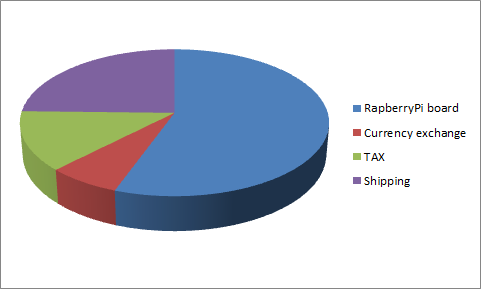
RaspberryPi total price pie chart by charges
Hope this will help to make educated choice and not get caught by surprise.
Aug
22
RaspberryPI – Unpacking
Filed Under news | Leave a Comment
After almost 2 months waiting my RaspberryPI finally is in my hands.
I’m sharing unpacking pictures:
-
- This is the package
-

- And this is what you will find inside.
-
- It is well packaged
-
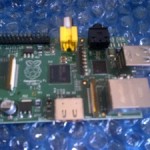
- And this is the hardware
Oct
6
Steve Jobs 1955-2011
Filed Under news | Comments Off on Steve Jobs 1955-2011

May
14
Angry birds for Browser :)
Filed Under fun, news | Leave a Comment
Good news the cult game for iOS has HTML5 version for Chrome OS.
And the better news it could be played from windows OS, but Google Chrome or Firefox 4 browser is requred.
I personally tested on Firefox.
And the bad news…
Of course there is one – it is really addicting.
You are warned 🙂
Aug
1
Kompozer 0.8b3
Filed Under Linux, news | Leave a Comment
From long time I did not update KompoZer page, but there was no stable version.
Anyway I’ve decided to publish an updated (even it is considered
development) version.
And for those of you who do not know the program:
KompoZer is a complete web authoring system that combines web file management and easy-to-use WYSIWYG web page editing.
KompoZer is designed to be extremely easy to use, making it ideal for non-technical computer users who want to create an attractive, professional-looking web site without needing to know HTML or web coding.
Visit my Kompozer RPM package page to download.
Nov
27
How to repair Linux(CentOS) software RAID
Filed Under Fix, Howto, news | Leave a Comment
Sooner or later hard drives fail…
That’s why we use RAID arrays. The best solution is to use hardware RAID – one assisted with specialized processor on the board. In that category I do not include cheap (called Fake RAID) solutions integrated on the motherboard.
But unfortunately sometimes real RAID controllers are too pricey – here on help comes software RAID.
The good news is that it is included in most of the recent OS. Linux does not make an exception and the software included is really well optimized and even recommended to achieve better performance over Fake RAID.
…
Now in case of failure we are protected, but RAID 1 and 5 will protect the data in case of one drive failure so it is better to replace the failed drive as soon as possible, but on other side you do not want to stop the machine right now.
NOTE: If you have IDE HDD do not use following procedure. IDE drives are NOT HOTSWAPPABLE and removing it may cause MORE DAMAGE.
This is valid also for ordinary s-ATA and SCSI drives.
In case that you have hotswappable drive SCA or similar you can replace the drive when the machine is working.
If you are not sure check the documentation that come with your hardware.
And now after all this precautions let’s start:
Determine the failed drive
To check what array and what drive have problem simply type:
cat /proc/mdstat
Here is sample output:
md2 : active raid5 sdd2[4](F) sda2[0] sdc1[2] sdb2[1]106221312 blocks level 5, 256k chunk, algorithm 2 [4/3] [UUU_]In this case the problem is sdd.
Check drive size and type
For the size type:
fdisk -lAnd look for sdd in the output.
To check exact drive model type:
dmesg|lessand again look just before SCSI device sdd:
Next step is to obtain replacement drive
(ideally the same model)
Dump the partition table from the drive, if it is still readable:
sfdisk -d /dev/sdd > partitions.sddRemove the drive to replace from the array:
mdadm /dev/md2 -r /dev/sdd2Look up the Host, Channel, ID and Lun of the drive to replace,
by looking in
cat /proc/scsi/scsiRemove the drive from the bus
echo "scsi remove-single-device 1 0 3 0" > /proc/scsi/scsiVerify that the drive has been correctly removed
by looking in
cat /proc/scsi/scsiPhysically replace the drive
Unplug the drive from your SCA bay, and insert a new drive
Add the new drive to the bus:echo "scsi add-single-device 1 0 3 0" > /proc/scsi/scsi(this should spin up the drive as well)
Recreate the layout
Re-partition the drive using the previously dumped partition table:
sfdisk /dev/sdd < partitions.sddIf failed drive was unreadable here you need to create new partitions
Add the drive to your array
mdadm /dev/md2 -a /dev/sdd2You can check if the operation was successful by issuing
cat /proc/mdstat Inspired with modifications fromNov
13
First 45-nm CPUs from AMD
Filed Under news | Leave a Comment
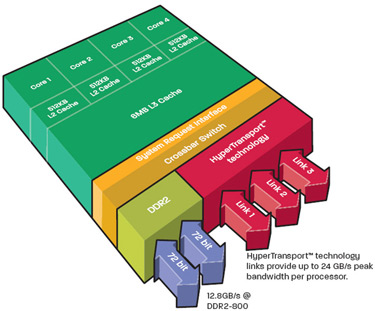
AMD officially announced first Quad Core 45-nm Opteron CPUs code name “Shanghai”.
They are not only up to 35% faster than previous line but also consume 35% less power. In addition improvements in virtualization can increase performance up to 40%.
They use improved Direct Connect Architecture in conjunction with HyperTransport 3.0 and AMD-V including new Rapid Virtualization Indexing feature.
New 45-nm process allowed to increase L3 cache size up to 6M.
Nov
11
newegg comes in Canada…
Filed Under news | Leave a Comment
newegg leading online retailed for conputer related equipment now expands in Canada.
New site is accessible here:

You must be logged in to post a comment.